Updated
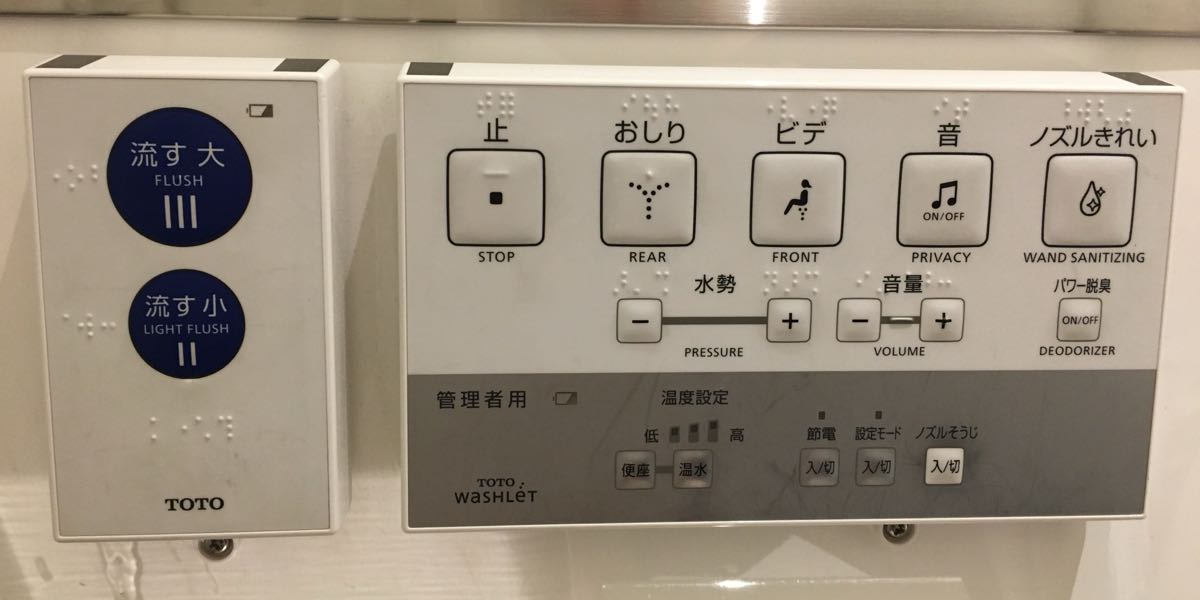
Photo: TOTO Washlet controls in Japan by Phil Whitehouse, CC BY 2.0, cropped.
.jpg)
Japan is famous for its clean and high-tech toilets — but for first-time visitors, they can also be a bit confusing. The good news: toilet etiquette in Japan is simple once you know a few basic rules. Following them will help you avoid awkward situations and show respect in shared spaces.
🧻 Types of Toilets in Japan
You’ll usually encounter two main types.
🚿 Western-Style Toilets

These are the most common, especially in cities. Sit down as usual and flush with a button or lever. Many include “washlet” (bidet) functions, such as water sprays, heated seats, and air dryers.
🎛️ Washlet Buttons Explained
Control panels are usually on the armrest or on the wall beside you. Many have small pictograms, but these are the words to look for:
- 流す (nagasu): flush. Often split into 大 (dai, big flush) and 小 (shō, small flush).
- おしり (oshiri): rear wash spray.
- ビデ (bide): bidet, a front wash for women.
- 止 (tomeru): stop. Look for a square ■ symbol, often on an orange button. Press it to stop any spray.
- 乾燥 (kansō): warm-air dryer.
- 水勢 (suisei): water pressure, usually with + and − buttons.
- 便座 (benza): seat temperature.
- 音姫 (otohime) or 擬音 (gion): privacy flushing sound.
For every button, the pictograms and a step-by-step guide, see Japanese toilet buttons explained.
Some toilets flush automatically when you stand up. Others have a sensor on the wall you wave your hand over. If there's no obvious lever, look for a small panel with a hand icon.
🏯 Japanese-Style (Squat Toilets)

Less common, but still found in older buildings and some public places. To use: face the hood (front part), place your feet on the marked areas, and squat down. Our step-by-step squat toilet guide covers the details, and how to find a Western-style stall instead.
🧠 Basic Toilet Etiquette
🚿 Flush Everything
In Japan, toilet paper goes in the toilet. It’s designed to dissolve in water. Do NOT throw it in the bin.
✨ Leave It Clean
Always leave the space as you found it: wipe the seat if needed, avoid splashing water, and don’t leave trash behind. For non-paper items (hygiene products, diapers), use the small bins provided, often labelled 汚物入れ (obutsu-ire). Never flush them, since Japanese plumbing isn’t designed for them.
🔇 Be Considerate of Others
Some toilets include a “sound” button (Otohime/Sound Princess) that plays a flushing noise for privacy. It’s commonly used, but completely optional.
🚶 Queue in One Line
When there’s a queue, people usually form one line at the entrance and take the next free stall, rather than waiting in front of individual doors. Join the end of the line, even if a stall looks close to opening.
🔒 Locks and Knocking
Door locks usually show red for occupied (使用中, shiyō-chū) and blue or green for vacant (空き, aki). If you can’t tell, a light knock is fine. Someone inside will often knock back to say it’s taken.
🙌 Washing Your Hands
Soap is almost always provided, but paper towels often aren’t. Hand dryers are common but are sometimes switched off. Many people in Japan carry a small hand towel or handkerchief for this reason. It’s a good habit to pick up while you travel.
♿ Multi-Purpose Toilets
Larger rooms marked 多目的トイレ (tamokuteki toire) or 多機能トイレ (takinō toire) are designed for wheelchair users, parents with small children, older people and ostomates. Anyone can use them, but if you don’t need the extra space, use the regular toilets so they stay free for people who do.

👟 Slippers (Important!)
In traditional locations like homes or some restaurants, you may see toilet slippers. Change into them before entering, and switch back when leaving. Don’t walk outside the toilet area wearing them!
You’re most likely to meet them in ryokan (traditional inns), temples, izakaya with tatami rooms and people’s homes. The system is simple: outdoor shoes stay at the entrance, indoor slippers are for hallways, and toilet slippers stay in the toilet. Leave them neatly where you found them for the next person.
⚠️ Common Mistakes Tourists Make
- ❌ Not flushing toilet paper
- ❌ Standing incorrectly on squat toilets
- ❌ Pressing random washlet buttons (and panicking)
- ❌ Leaving the toilet messy
- ❌ Ignoring slippers in traditional places
🌾 Rare Cases (Rural Areas)
In some countryside locations, you might encounter older toilets with no automatic flush. These are uncommon, especially in cities like Osaka.
💡 Good to Know
- Most public toilets in Japan are free.
- They’re usually clean and well-maintained.
- Toilet paper is almost always available.
What If You’re Not Sure?
If you’re ever unsure, follow what others do or look for icons. If you are worried about finding a toilet quickly, check out our other guides:
- Japanese toilet buttons explained
- How to find toilets in Japan
- How to ask for a toilet in Japanese
- Are toilets free in Japan?
- How to ask to use a café or restaurant toilet
- The Tokyo Toilet: Shibuya's designer toilets
- Toilets on Japanese trains
- How to use a Japanese squat toilet
Find the nearest free toilet instantly.
Get the Sugu Toire widget to see walking times and distances to the closest restroom right on your home screen.
Get the App