
Updated
You sit down, turn to find the flush, and there it is: a panel with a dozen buttons, all labelled in kanji. Japan's high-tech toilets are one of the country's small wonders, but the first encounter can feel like a cockpit. The good news? You only need three buttons, and the rest are easy once you know what the characters mean.
“Washlet” is actually TOTO's brand name, but in Japan and abroad people use it for any toilet seat with a built-in bidet. Other makers call theirs something else (LIXIL's is the “Shower Toilet”), but the buttons work the same way.
📍 Where to Find the Controls
Before you can press anything, you have to find the buttons. There are three common setups:
- Armrest panel: a strip of buttons attached to the side of the seat, usually on the right. Common in homes, hotels and older public toilets.
- Wall-mounted remote: a slim panel on the wall beside you, often next to the toilet paper holder. This is standard in newer buildings, department stores and stations.
- Sensors: some toilets have no flush button at all. They flush automatically when you stand up, or have a sensor on the wall that you wave your hand over.
Older toilets without a washlet just have a lever on the tank, like anywhere else. Some public toilets also have a separate flush button on the wall above or behind the toilet.
🎛️ The Main Buttons
Most wall panels look something like this. The exact layout depends on the maker and model, but the labels are standard:
And here's a real one, a TOTO Washlet panel in a Japanese toilet. The flush buttons are on a separate panel on the left, and each button has an English label and a pictogram:
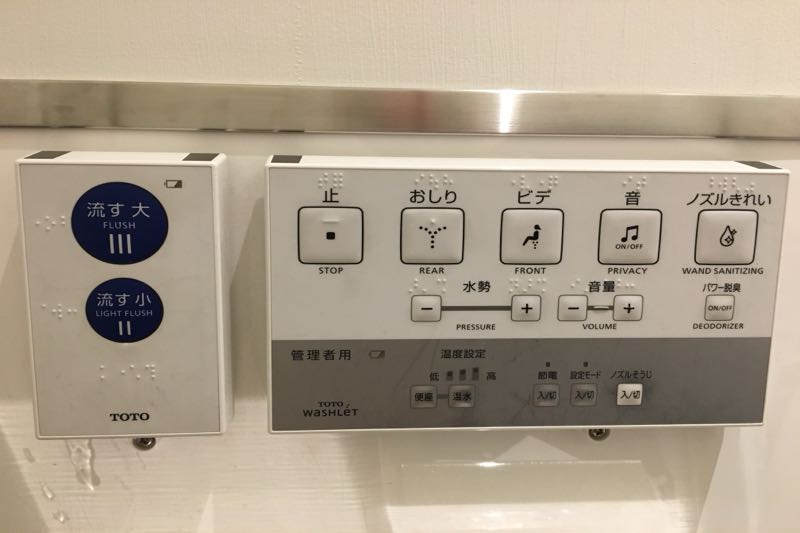
Every Button, Explained
Here's what the labels mean, starting with the ones you'll actually use:
| Label | What it does |
|---|---|
| 止tomeru | Stop. Stops any spray or the dryer. Look for a square ■ symbol. On many panels the button itself is orange. |
| 流すnagasu | Flush. Often split into 大 (dai, a full flush) and 小 (shō, a smaller flush that saves water). |
| おしりoshiri | Rear wash. A warm-water spray for your bottom. |
| ビデbide | Bidet. A gentler front wash, designed for women. |
| 乾燥kansō | Dryer. Blows warm air. It's slow, so most people just use paper. |
| 音姫otohime | Privacy sound. Plays a flushing-water sound to cover other noises. Also labelled 音 (oto), 擬音 (gion) or 流水音 (ryūsuion). Some play automatically when you sit down. 音量 (onryō) sets the volume. |
| 水勢suisei | Water pressure. Adjust with − and +. Sometimes labelled 強弱 (kyōjaku, strong/weak). |
| 位置ichi | Nozzle position. Moves the spray forward or back. |
| 水温suion | Water temperature. |
| 便座benza | The seat. On its own it usually raises or lowers the seat. 便座温度 (benza ondo) sets the seat temperature. |
| 便ふたbenfuta | The lid. Opens or closes it. |
| ムーブmūbu | Moving spray. The nozzle moves back and forth while it washes. |
| マッサージmassāji | Massage. A pulsing spray. |
| ノズル洗浄nozuru senjō | Nozzle cleaning. Extends and rinses the nozzle. For cleaning, not for you. Also labelled ノズルきれい (nozuru kirei) or ノズルそうじ (nozuru sōji). |
| 脱臭dasshū | Deodoriser. |
| 節電setsuden | Power saving. Lowers or switches off the seat heater when the toilet isn't being used. |
| 管理者用kanrisha-yō | “For staff.” Settings for whoever maintains the toilet, like temperature and power saving. You can ignore everything in this section. |
🖼️ Reading the Pictograms
Many panels also have small icons next to the kanji. In 2017, Japan's major toilet manufacturers agreed on a shared set of eight pictograms, so newer toilets use the same symbols regardless of brand. They cover the lid, the seat, full and small flush, rear wash, bidet, dryer and stop.
- Stop: a solid square, like the stop button on a music player.
- Rear wash and bidet: a seated figure with a spray. The spray points further forward for the bidet.
- Flush: marked 大 (full) or 小 (small).
If the kanji are hard to read, the icons are usually the quickest way to find the button you need.
🚿 How to Use a Washlet, Step by Step
- Sit down. On most models the spray only works while you're seated, because a sensor in the seat detects you. Pressing the spray buttons while standing usually does nothing.
- Press おしり (or ビデ). A small nozzle slides out from under the seat and starts spraying warm water.
- Adjust if needed with 水勢 (pressure) or 位置 (position). Start low: some are set stronger than you'd expect.
- Press 止 to stop. The nozzle retracts by itself.
- Pat dry with toilet paper, or use 乾燥 if you're patient.
- Flush with 大 or 小. Some toilets flush automatically once you stand up.
That's it. You never have to use the spray. The flush works exactly like any other toilet.
🆘 Troubleshooting
The spray won't stop!
Press 止. If you can't find it, stand up: on almost all models, the spray stops as soon as the seat sensor no longer detects you.
I can't find the flush
Check the wall beside you for a remote panel, then look for a sensor with a hand icon. On toilets with a tank, try the lever on the side. If nothing works, stand up and wait a moment, since many modern toilets flush automatically.
The lid opened by itself
Many newer toilets have a motion sensor that opens the lid when someone walks in. Some also close the lid and flush when you leave. Nothing's wrong.
Why is the seat warm?
It's heated on purpose, and it's a feature Japanese people love in winter. It doesn't mean someone just left.
I pressed the emergency button by accident
Don't panic. Staff may come to check or speak through an intercom. Just tell them:
🧼 Is the Washlet Hygienic?
Yes. The nozzle stays tucked away under the seat when it's not in use, and many models rinse it automatically before and after each wash. Some use electrolysed water or UV light for extra cleaning. Public toilets are also cleaned several times a day. If you'd rather not use the spray, you don't have to, and nobody will know.
❓ Frequently Asked Questions
Do I have to use the washlet?
No. It's completely optional. Plenty of people only ever use the flush.
Does it cost anything?
No. Washlets are standard in public toilets, and using them is free. See Are toilets free in Japan?
Why are there two flush buttons?
大 (big) is a full flush and 小 (small) uses less water. Use 小 when you only need a light flush.
What about squat toilets?
They don't have washlet functions, just a flush lever or button. Our squat toilet guide explains how to use one.
Find the nearest free toilet instantly.
Get the Sugu Toire widget to see walking times and distances to the closest restroom right on your home screen.
Get the App