Updated
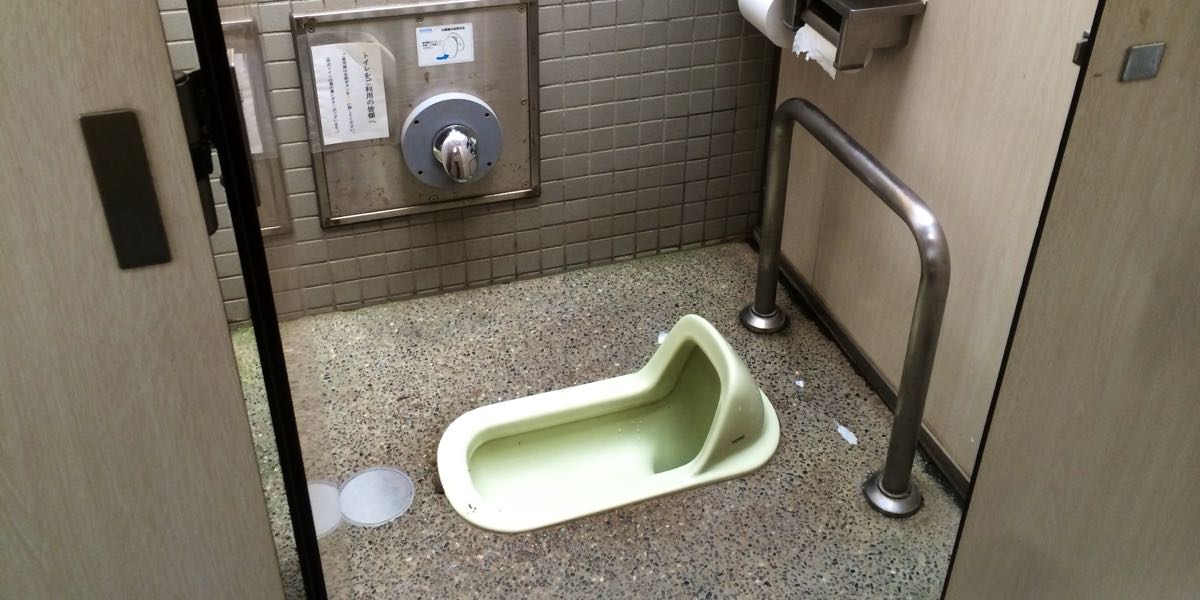
Photo: squat toilet at Hamarikyu Gardens, Tokyo, by Steven L. Johnson, CC BY 2.0, cropped.
.jpg)
Most toilets you'll meet in Japan are high-tech Western-style washlets. But open the wrong stall door in an older station, a park or a temple, and you may find a porcelain trough set into the floor. That's a Japanese squat toilet. It looks intimidating the first time, but it takes about ten seconds to learn.
🚽 What Is a Japanese Squat Toilet?
In Japanese, a squat toilet is 和式 (washiki, “Japanese-style”) and a sit-down toilet is 洋式 (yōshiki, “Western-style”). The squat toilet is a long, shallow bowl set into the floor, with a rounded, raised end called the hood (金隠し, kinkakushi).
Western toilets have been winning for a long time. Sales of Western-style toilets overtook squat toilets in Japan back in 1977, and today almost every home, hotel, department store and new building uses them. Squat toilets are now mostly found in older public facilities.
📍 Where You'll Still Find Them
- Older train stations, especially small local ones
- Parks and gardens
- Temples and shrines
- Schools and older public buildings
- Traditional restaurants in older buildings
- Rural areas, where facilities are generally older
Many public restrooms have a mix: several squat stalls and one or two Western ones. So before you resign yourself to squatting, check the doors.
🚪 How to Find a Western-Style Stall Instead
- Read the door: stalls are often labelled 洋式 (Western) or 和式 (squat), sometimes with a small pictogram of each type.
- Check the sign outside: some restrooms show a diagram of which stall is which, or a panel showing which stalls are free.
- Try the multi-purpose toilet: the larger 多目的トイレ (tamokuteki toire) is designed for wheelchair users, so it almost always has a Western-style seat. Use it only if you need to, and keep it quick.
- Go somewhere newer: a convenience store, department store or shopping mall will almost certainly have Western-style toilets. See how to find a toilet in Japan.
🧭 How to Use It, Step by Step
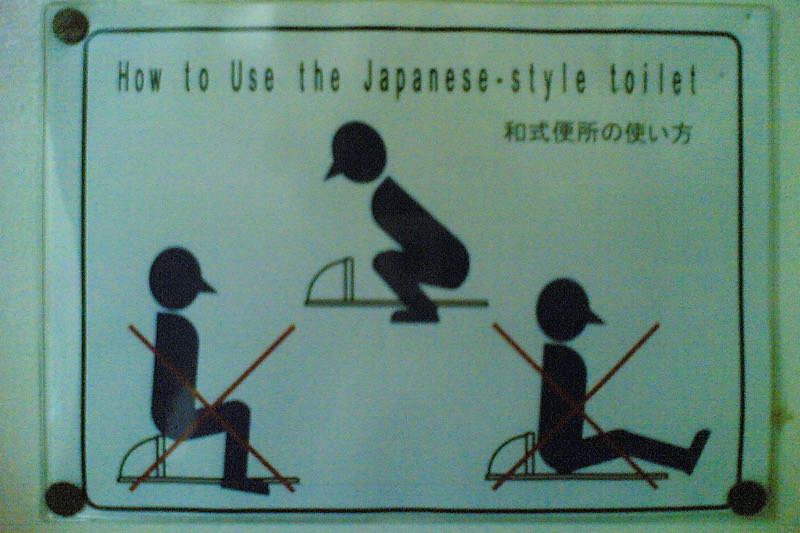
- Face the hood. Stand over the toilet so the raised, rounded end is in front of you. In most stalls this means you face the back wall, with the door behind you.
- Step over the bowl. Put one foot on each side, on the flat edges. Some toilets have textured footrests to show you where.
- Lower your clothes to your knees, not your ankles, and hold them forward so they stay clear of the floor and the bowl.
- Squat all the way down. Keep your feet flat if you can. If there's a handrail, use it for balance.
- Toilet paper goes in the bowl, just like with a Western toilet. Sanitary products go in the small bin.
- Stand up and flush. Look for a lever or button on the wall or on the pipe behind the toilet. Some have a foot pedal, and some have separate 大 (big) and 小 (small) flushes.
💡 Tips That Make It Much Easier
- Empty your pockets first. Phones, wallets and train passes fall out of pockets when you squat, and there's nothing to stop them landing in the bowl.
- Hang up your bag. Use the hook on the door, or hold it on your lap. The floor is not the place for it.
- Roll up long trousers or skirts before you start.
- Carry pocket tissues. Squat toilets tend to be in older facilities, and some small stations don't stock paper at all.
- Bad knees? Don't force it. Use the handrail, or look for a 洋式 stall or multi-purpose toilet instead.
- Men urinating should use the urinals. Squat toilets are for everything else.
🤔 Wait, Which Way Do I Face?
This question comes up surprisingly often, even in Japan. In 2017, a claim went viral on Japanese social media that everyone had been using squat toilets backwards, and that you should face away from the hood. Japanese news site Nlab asked TOTO, Japan's biggest toilet maker, and the answer was clear: the hood goes in front of you.
❓ Frequently Asked Questions
Is there always a Western-style option?
In cities, almost always, either in the same restroom or somewhere nearby. In rural areas and older parks, sometimes there's only a squat toilet.
Do squat toilets have washlets?
No. They just have a flush. For the high-tech kind, see our guide to Japanese toilet buttons.
Are they clean?
Public toilets in Japan are generally well kept, and squat toilets are no exception. There's also no seat to touch.
Will I find them on trains?
Rarely. Modern trains have Western-style toilets, though a few older local trains still have squat toilets. See toilets on Japanese trains.
Find the nearest free toilet instantly.
Get the Sugu Toire widget to see walking times and distances to the closest restroom right on your home screen.
Get the App